Air Cooling vs. Liquid Cooling: Which Is Better for High-Density Servers?
Keywords: air cooling vs liquid cooling, high-density server cooling, data center liquid cooling
Author: longXing Team
Introduction
Air cooling and liquid cooling remove heat from servers in different ways. Air systems move conditioned air through electronic equipment and reject the heat through mechanical cooling equipment. Liquid systems carry heat through a coolant loop located close to, or in direct contact with, high-heat components. For high-density servers, liquid cooling often provides greater heat-removal capacity, but air cooling remains practical for many workloads. The best choice depends on rack density, server design, climate, water strategy, facility readiness, and operational capability.
How the Two Methods Work
Air Cooling
A conventional air-cooled data center supplies cool air to server inlets and collects hot exhaust. Computer-room air handlers, direct-expansion units, in-row coolers, or rear-door heat exchangers then transfer the heat to an outdoor system. Hot-aisle or cold-aisle containment reduces recirculation. Air cooling is familiar, widely supported, and relatively easy to service, but higher rack loads demand more airflow, fan power, coil capacity, and careful pressure management.
Liquid Cooling
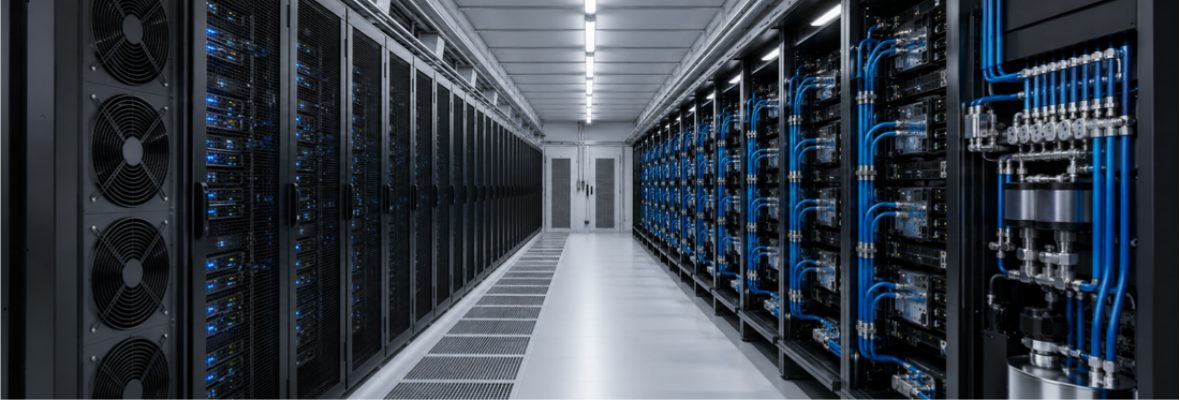
Direct-to-chip systems circulate coolant through cold plates attached to processors and accelerators. A cooling distribution unit separates the technology loop from the facility-water loop and controls flow, temperature, and pressure. Immersion systems place compatible IT equipment in dielectric fluid, although they require a different service model. Liquid has much greater heat-carrying capability than air, enabling heat to be captured near its source.
Performance at High Rack Density
Where Air Reaches Practical Limits
There is no universal rack-power threshold at which air cooling stops working. The limit depends on server airflow, rack layout, containment, supply temperature, altitude, climate, and cooling equipment. However, increasing density makes air delivery progressively harder: fans consume more power, noise rises, and small airflow problems create hot spots. Adding more room cooling does not solve poor distribution at the rack inlet.
Why Liquid Supports AI Loads
Liquid cooling can remove concentrated processor heat without forcing all of it through a crowded aisle. This improves density potential and can reduce server fan energy. Warmer coolant may also create opportunities for efficient heat rejection or heat reuse. Yet most direct-to-chip servers still reject some heat to air, so designers must quantify the residual air load. A liquid-ready module is usually a hybrid thermal system, not an air-free room.
Cost and Operational Tradeoffs
Infrastructure Requirements
Air-cooled facilities use mature supply chains and may have lower transition costs for moderate-density equipment. Liquid cooling adds cooling distribution units, pumps, manifolds, hoses, couplings, water treatment, controls, and leak detection. Retrofitting may require new pipe routes and structural changes. Conversely, liquid cooling can reduce the space and energy associated with moving large air volumes, so lifecycle economics can improve at sustained high density.
Maintenance and Risk
Air systems require filter, fan, coil, and airflow maintenance. Liquid systems add fluid quality, connection integrity, pump availability, and materials compatibility to the operating program. Properly engineered liquid cooling is not inherently unreliable, but teams need training, spares, isolation procedures, and server-vendor-approved maintenance methods. Facility and IT responsibilities must be clear at the rack interface.
Which Cooling Method Should You Choose?
Choose air cooling when rack loads are moderate, equipment is air-cooled by design, operational simplicity is important, or the existing facility has sufficient airflow and heat-rejection capacity. Choose liquid cooling when accelerator density, performance, energy constraints, or space limitations make air delivery impractical. Consider a hybrid system when the hardware combines liquid-cooled processors with air-cooled memory, storage, networking, or power supplies.
Use a Workload-Based Decision
Compare options with a rack-by-rack heat map, server environmental requirements, peak load, redundancy target, outdoor design conditions, water availability, energy price, maintenance capability, and expansion plan. Pilot the actual server configuration and test failure modes before scaling. For high-density servers, liquid cooling is often the stronger technical platform; the better business solution is the one that removes the full heat load reliably across its lifecycle.
Plan for Transition
If density will rise gradually, reserve pipe routes, electrical capacity, floor space for cooling distribution units, and controls integration before liquid-cooled racks arrive. A staged hybrid design can protect current investments while avoiding a rushed retrofit later.


