What Systems Make Up a Containerized Data Center?
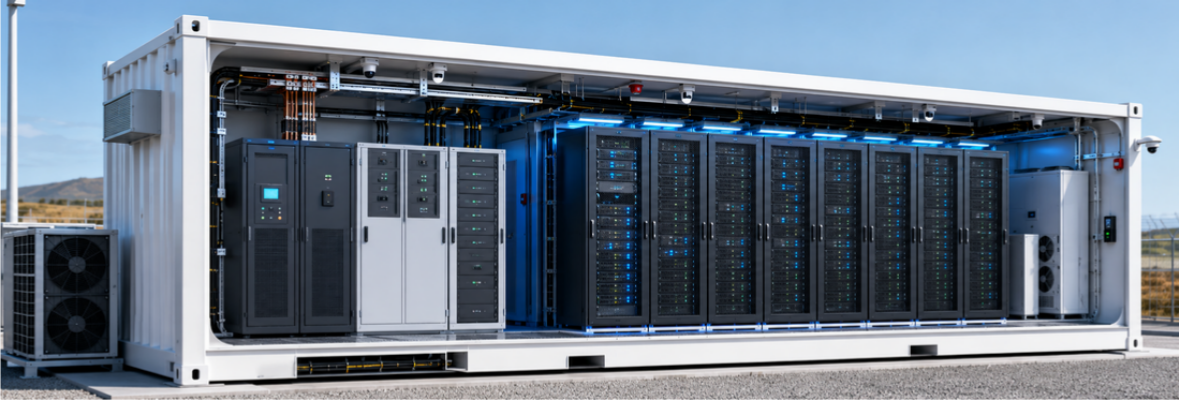
Keywords: containerized data center systems, modular data center components, data center infrastructure
Author: longXing Team
Introduction
A containerized data center is more than a shipping container filled with servers. It is an integrated facility that combines IT space with the power, cooling, safety, security, and control systems required to operate digital equipment reliably. Some products place every function in one enclosure, while larger deployments use separate IT, power, and cooling modules. Understanding these systems helps buyers define scope, compare proposals, and avoid missing site infrastructure.
Core IT and Network Systems
Racks, Cabling, and Connectivity
The IT zone contains standardized racks for servers, storage, and network equipment. Rack power density, usable rack count, aisle clearance, floor loading, and maintenance access determine how much computing the module can support. Structured copper and fiber cabling connect racks to switches, external carriers, and other modules. Overhead trays or segregated pathways keep data cables away from power conductors and make future changes easier.
Airflow Management
Rack orientation normally creates hot and cold sides. Containment panels, blanking plates, sealed cable openings, and controlled fan paths prevent hot exhaust air from mixing with supply air. Good airflow management is essential even when liquid cooling is used, because memory, storage, power supplies, and networking equipment may still reject heat to the air.
Power Infrastructure
Utility Input, UPS, and Distribution
Incoming power passes through switchgear and protective devices before reaching uninterruptible power supply equipment. The UPS maintains power during short utility interruptions and bridges the start-up time of standby generators where they are included. Power distribution units, remote power panels, busways, and intelligent rack PDUs deliver power to each rack. Metering tracks load, voltage, current, energy, and available capacity.
Redundancy and Grounding
Power paths may be designed as N, N+1, or 2N depending on the availability requirement. Dual-corded IT equipment can receive independent A and B feeds. Earthing, bonding, surge protection, emergency power-off logic, and selective protection coordination are equally important. The module must also connect correctly to the site transformer, generator, fuel system, and grounding network.
Cooling and Environmental Control
Air or Liquid Heat Removal
Air-cooled modules may use direct-expansion units, chilled-water coils, in-row coolers, or wall-mounted systems. Sensors regulate temperature, humidity, and fan speed. High-density modules can add rear-door heat exchangers, cold-plate loops, cooling distribution units, pumps, and facility-water connections. Cooling capacity must be evaluated at the specified outdoor temperature and IT load, not only under nominal test conditions.
Safety, Security, and Monitoring
Fire and Physical Protection
Fire systems typically combine early smoke detection, alarms, shutdown sequences, and an approved suppression method. Doors, locks, access readers, cameras, intrusion sensors, and exterior lighting protect the enclosure. Structural design, insulation, weather sealing, corrosion protection, water detection, and rated cable penetrations help the module withstand its operating environment.
Controls and DCIM Integration
A supervisory controller collects alarms and operating data from UPS units, cooling equipment, rack PDUs, environmental sensors, fire panels, and security devices. It may connect to a building management system or data center infrastructure management platform through standard protocols. Remote dashboards allow operators to trend energy use, identify capacity limits, and respond to faults without permanent staff on site.
Do Not Forget the Site Systems
A complete solution also needs foundations, drainage, utility capacity, network routes, external heat rejection, generators, fuel, fencing, access roads, and lifting space. Factory acceptance testing verifies the integrated module before shipment; site acceptance testing confirms operation after connection. The most useful specification defines every interface, design condition, redundancy target, responsibility, and acceptance test. That turns a collection of components into an operable containerized data center.
How the Systems Work Together
Integration logic links the infrastructure during normal operation and faults. For example, a utility failure should transfer the IT load to the UPS, start standby generation, preserve cooling, and report status remotely. A fire alarm may stop selected fans, close dampers, isolate power, and release suppression according to the approved cause-and-effect matrix. Testing these sequences is as important as testing individual devices, because interface failures often appear only when several systems respond at once.


